A claim about hydrated skin can describe several different things: how a face looks to an observer, how comfortable it feels to its owner, or a reading from an instrument. Those are separate questions. Before deciding whether a result sounds impressive, identify which question produced the number. Otherwise, a precise percentage can create a very imprecise impression of what changed.
The central study is a conference abstract, not a full peer-reviewed trial report. The evidence snapshot and figure keep its findings together; the examples below explain how to interpret measurements without converting one outcome into another. Every invented numerical example is labeled and is separate from the research results. The aim is to make a claim traceable: from the thing assessed, through the comparison performed, to the conclusion a reader is considering.
Study figure and data
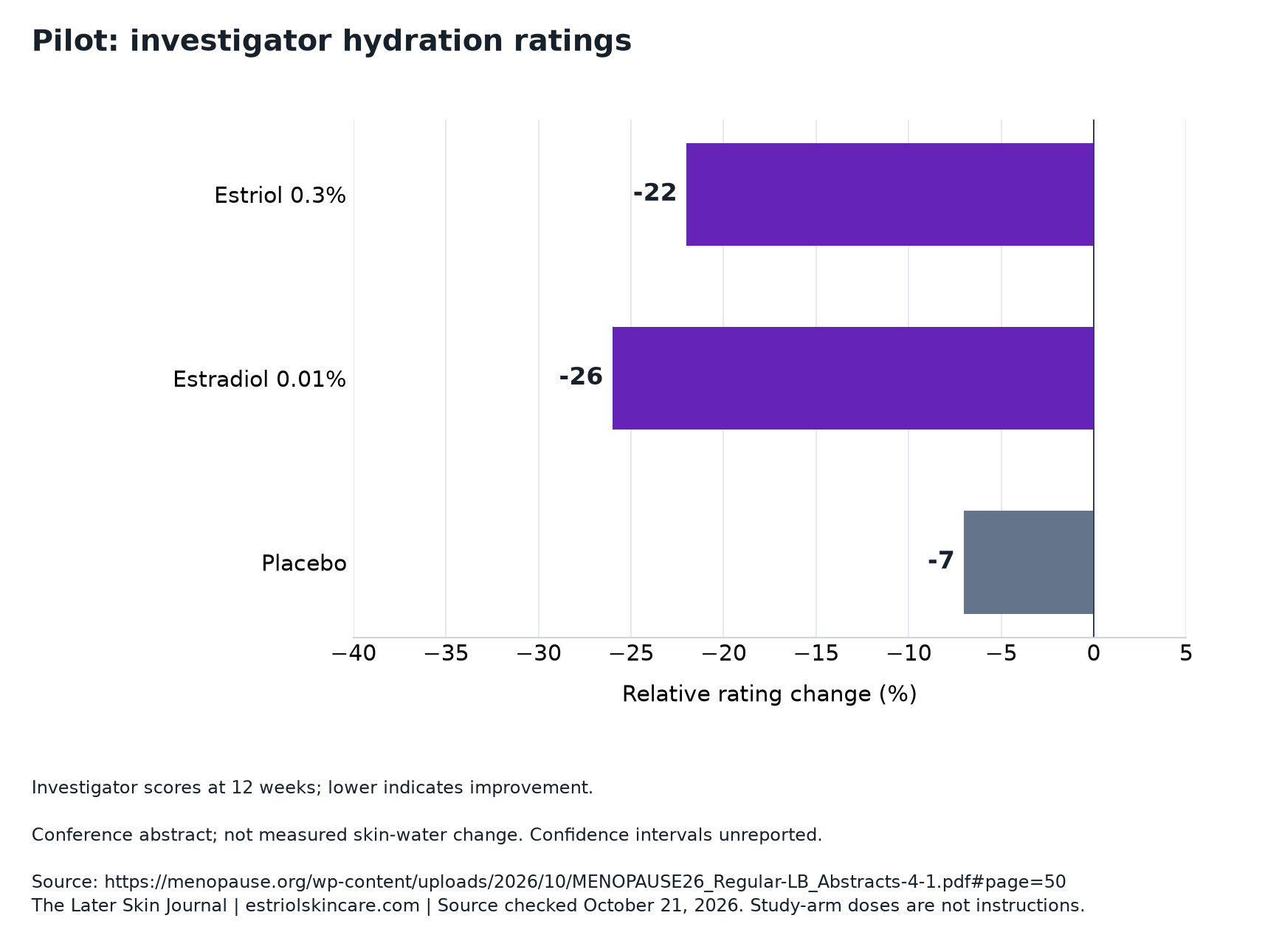
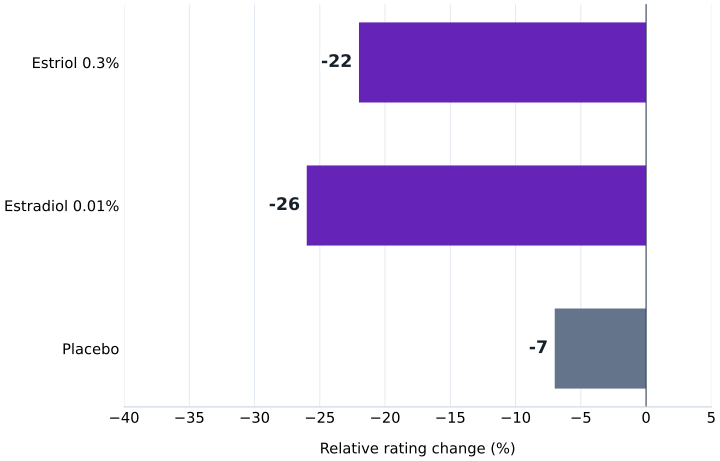
Pilot: investigator hydration ratings
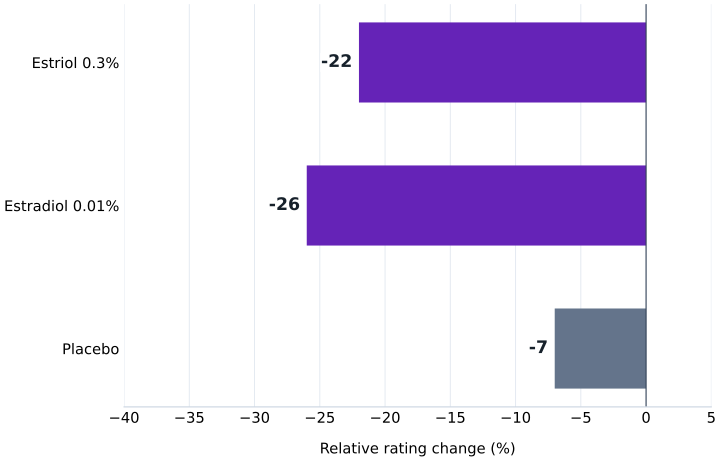
Investigator scores at 12 weeks; lower indicates improvement.
Conference abstract; not measured skin-water change. Confidence intervals unreported.
Download chart (PNG)Download data (CSV)Download vector chart (SVG)
| Historical cream arm | Reported value |
|---|---|
| Estriol 0.3% | -22 |
| Estradiol 0.01% | -26 |
| Placebo | -7 |
Name the quantity before interpreting the number
Start a measurement record with a noun rather than a verdict. Write appearance rating, comfort rating, or instrument reading before writing improved. Then add who made the assessment, what was assessed, and when. This is an editorial way of keeping different questions separate; it does not rank one kind of evidence above another. A person can give a meaningful account of comfort without that account measuring the amount of water in a piece of skin.
Imagine designing a questionnaire about morning tightness. A question about tightness immediately after washing differs from one about the worst tightness during the week. Even if both use the same numbered answers, their time windows make them different measurements. A device reading collected at a visit answers another question again. Agreement among these measures would be interesting; their shared number of response options would not establish agreement.
The results-journal guide offers a place to organize observations. For research reading, use the same discipline on a smaller scale: preserve the original label beside every copied value. The table below is a proposed reading worksheet, not a description of any study instrument.
| Field to preserve | Example question | Reason to preserve it |
|---|---|---|
| Assessor | Who supplied the answer? | Keeps observer and participant perspectives distinct. |
| Target and timing | What was assessed, over which interval? | Prevents different questions from sharing one label. |
| Scale or unit | What does one numerical step represent? | Makes the arithmetic interpretable. |
| Comparison | Compared with which reference? | Separates a change from an effect estimate. |
A score point is different from a percentage
Consider invented group summaries on an unspecified symptom scale: 3.0 at the beginning and 2.4 later. Subtracting gives a change of −0.6 score points. Dividing that change by the starting value gives −20%. In a second invented group, 1.0 becoming 0.8 also gives −20%, although the absolute change is only −0.2 points. The equal percentages do not tell us that the experiences, starting burdens, or final states were equal.
The arithmetic is straightforward; the meaning of the scale needs separate attention. Numbered categories establish an order when higher answers represent more of a symptom. Equal numerical steps do not, by themselves, prove equal differences in experience. Nor does a zero category necessarily establish a physical zero that makes ratios meaningful in the same way as a measured quantity. A percentage calculation can therefore be reproducible while its practical interpretation remains unsettled.
When reading a plotted percentage, keep both the denominator and the unit visible. Ask for the starting and ending summaries, the rules used to combine individual scores, and an explanation of why that change matters. Do not translate a score reduction into a percentage of people helped: that would require a separately defined person-level outcome and its denominator.
Separate a change from a treatment comparison
Here is another invented example, using an arbitrary instrument unit. A treatment group begins at 40 and finishes at 50; a comparison group begins at 40 and finishes at 46. Their changes are +10 and +6 units. Subtracting the changes gives +4 units. The treatment group’s own increase is 25%, but that is a different calculation from the difference between groups. Neither calculation may be substituted for the other without changing the question.
Now suppose the comparison group began at 20 instead. A six-unit increase would represent 30% of its starting value. Comparing the two percentages would then mix different denominators. This is why a report’s stated analysis matters: change scores, final values adjusted for baseline, and relative changes are not interchangeable labels. The example illustrates that issue; it does not reconstruct an analysis from the facial research.
Another distinction concerns percentages of people. In invented response rates of 30% and 20%, the difference is 10 percentage points. Relative to 20%, the increase is 50%. Both expressions describe the same hypothetical contrast, but they emphasize it differently. A complete claim should name the response definition and denominator before choosing either expression.
Treat instrument names as part of the result
The 1996 indexed abstract compares estradiol and estriol compounds in 59 preclimacteric women over six months; it names corneometry and profilometry. Randomization, blinding and a vehicle comparator are not established there. Funding is unknown from that abstract. These details belong to that report and cannot supply missing methods for a different experiment.
For a hypothetical instrument result, write a miniature specification: device, output unit, sampled area, preparation conditions and timing. A recorded value of 48 is not self-explanatory. It might be an instrument index rather than a direct percentage of water. Without a definition, adding a percent sign would manufacture information. Similarly, a measure of stored quantity and a measure of movement over time ask different physical questions. Knowing one does not algebraically determine the other.
A useful methods question is whether another team could reproduce the measurement from the description. That asks for operational detail, not merely a more technical name. For an everyday concern, the dry-skin and moisturizer discussion helps organize what needs clarification before connecting a symptom to a product decision. A broad word such as hydration should remain broad until the actual measurement narrows it.
Check whose experience the outcome describes
An observer and a participant can answer different questions without either answer being meaningless. An observer may judge a feature under a defined viewing arrangement. A participant may summarize sensations across an ordinary day. To compare their answers fairly, first align the target, timeframe and response scale. Calling both answers efficacy does not perform that alignment.
Imagine a proposed diary that asks about comfort on two days. One participant records 1 and 5; another records 3 and 3. Both have an arithmetic mean of 3, but one pattern fluctuates and the other does not. If the practical question concerns unpredictable bad days, the mean alone discards relevant information. If the question concerns average burden, it may be useful. These are invented observations showing why the summary should follow the question.
Before choosing a summary, specify which experience would count as a worthwhile difference and how consistently it should occur. This also makes a later disagreement easier to investigate: did the measures capture different features, use different time windows, or simply remain uncertain? The routine-question guide can help keep a reader’s own concern explicit while reviewing evidence that may address only part of it.
Read a small P value alongside the estimate
A P value concerns how incompatible the observed data are with a specified statistical model, under its assumptions. It is not the probability that a treatment works, the probability that a conclusion is correct, or the size of an improvement. Those tempting translations skip information that the calculation does not contain.
In an invented comparison, a precisely estimated difference of 0.1 unit could be statistically persuasive yet too small to matter for the question being asked. A difference of 4 units with substantial uncertainty could remain practically interesting but unresolved. This is why an effect estimate, its uncertainty and a justified threshold for meaningful change belong together. Choosing a threshold after seeing the most favorable result would answer a different question from testing a threshold specified in advance.
When many outcomes are considered, also ask how the investigators planned to interpret the collection. A list of P values is not automatically a single coherent success criterion. Conversely, an unfavorable threshold crossing does not establish equality. Read the point estimate and the uncertainty around it before deciding what possibilities have been meaningfully narrowed. An unavailable interval should remain unavailable; a graph without one should not invite a reader to imagine a very narrow one.
Keep molecular questions on their own scale
The 2008 full paper separates protected-hip and facial experiments. Procollagen I messenger RNA (mRNA) is not a clinical appearance outcome. Randomization is unestablished. Figure 1A’s female n=18 conflicts with Table 1’s 17; the first protein concentration is 0.01% in the caption versus 0.1% in the narrative. Pfizer partly funded the work; a coauthor reported Pfizer consulting.
A useful thought experiment is to draw separate boxes for a molecular message, a measured protein, a tissue property and a person’s assessment. An arrow between boxes represents an additional question requiring evidence. It is not a promise that measuring the first box answers the last. The procollagen measurement article follows that distinction in more detail.
For an invented ratio, 2 units against a reference of 1 gives a twofold value. That is a 100% increase over the reference, not a 200% increase. But arithmetic alone cannot tell us whether twice the molecular signal means twice the tissue effect. It also cannot resolve a disagreement between a table and a caption. Preserve the disputed labels and keep conclusions that depend on them separate from measurements whose identity is clear.
Make a safety question specific
The 1993 indexed abstract followed 17 women using estradiol or estriol ointments for three months; serum-hormone and vaginal-smear changes were nonsignificant. A randomized vehicle comparison is not established, and funding is unknown. The 1996 abstract reports increased prolactin. These are bounded observations, not a single universal safety verdict.
A safety question needs an event or measurement, a population, a duration and a way of looking for it. A questionnaire about immediate discomfort cannot by itself answer a question about an event many years later. A laboratory measurement at selected visits does not continuously observe the interval between them. This is a logical limit of the question asked, even when every recorded value is correct.
For a purely invented probability illustration, suppose independent observations each have a 1% chance of an event. Across 20 observations, the probability of seeing none is 0.99 to the twentieth power, about 82%. This is not an estimate of risk for any cream; it shows why observing no event in a small sample can coexist with a nonzero underlying probability. The safety discussion helps turn a general reassurance into questions about the particular uncertainty and clinical circumstances involved.
Make claims survive a document handoff
FDA reports no approved estriol-containing drug and does not establish estriol products as safer than other estrogens. Compounded drugs lack FDA approval and its premarket assessment of safety, effectiveness and quality; they are not approved generics. Compounding may serve individual needs when an approved medicine is inappropriate. Registration of a facility does not turn its products into approved drugs.
Our editorial approach is to keep a research claim and an offer description in separate columns, then look for an explicit bridge. A matching ingredient name or printed percentage is only part of an identity. A reader would still need documentation connecting the preparation, population and outcome to the claim being considered. This is a way to organize evidence, not a finding about the equivalence or legal status of a particular product.
The CoreAge Rx review and Alloy review are useful places to examine documented offer terms. Write down the exact claim before following a citation; then check whether the cited result answers that claim with the same outcome, timeframe and comparator. A citation’s presence is the beginning of that check.
Ask what evidence would change the conclusion
A stronger next question is specific enough to be answered differently by different results. Instead of asking whether a cream improves skin, propose an outcome, a suitable comparator and a time window. Decide in advance how much change would matter, which analysis would estimate it, and what uncertainty would leave the question unresolved. These are suggestions for reading a future study, not a claim that such a protocol has already been completed.
Separate measurement reliability from treatment benefit. Repeating a reading under comparable conditions asks how stable the measurement is. Comparing appropriately designed treatment groups asks another question. A very repeatable measure can capture something peripheral to the patient’s concern; a relevant concern can be measured poorly. Both problems deserve attention before an attractive numerical result becomes a broad conclusion.
Use the table as a checklist for a focused follow-up question. The research-reading guide provides wider context for comparing records. A useful endpoint for this exercise is a sentence that states what remains uncertain and which observation would reduce that uncertainty. That is more informative than trying to force every measurement into a single verdict about effectiveness.
| Question to settle | Information to request | What the answer would clarify |
|---|---|---|
| Does the measure match the concern? | Exact wording, target and observation period. | Whether the outcome answers the intended question. |
| How large is the contrast? | Estimate, unit, comparator and uncertainty interval. | The size and precision of the difference. |
| How were incomplete observations handled? | Participant flow and analysis rules. | Whose information contributes to the result. |
| Was the conclusion planned? | Prespecified outcomes and interpretation rules. | How the finding relates to the original question. |
Questions about the evidence
Can I compare two percentages printed in different advertisements?
First identify each numerator, denominator, outcome and time window. A percentage of people answering a question differs from a percentage change in a group score. Even matching units do not establish comparable populations or comparisons. If those details are unavailable, the two numbers cannot support a clear numerical ranking.
Does a more technical measurement automatically answer a better question?
No. Technical detail can make a method easier to identify, but relevance depends on the question. A reader asking about comfort needs evidence connected to comfort. A molecular measurement may address a useful scientific question while leaving that concern open. Decide what you need to know before assigning importance to the instrument.
What should I do with an inconsistent caption or table?
Record both versions and identify which conclusion depends on the difference. Do not average the labels, select the more appealing value, or silently repair the record. A clarification from the investigators or a corrected report could resolve the issue; until then, distinguish secure observations from interpretations that require the disputed detail.
Can a personal diary reproduce a controlled experiment?
A diary can organize the timing and wording of observations. It cannot create a comparison group or isolate a treatment effect by itself. Its most useful role is to make a concern describable and to preserve changes worth discussing, while keeping the explanation for those changes separate from the observations.
What is a useful question to take to a clinical conversation?
Ask which outcome matters for your concern, what evidence connects the proposed option to that outcome, and which uncertainty would affect the decision. Bring the precise claim or figure rather than only its headline. The answer may involve evidence, product documentation and individual circumstances that a general research article cannot combine for you.
Editorial assessment
The most useful reading habit is to keep the full question attached to the number. Preserve the assessor, target, scale, timeframe and comparator, then distinguish the estimate from the uncertainty around it. Check a percentage with simple arithmetic, but do not let correct arithmetic supply missing meaning. A well-defined measurement can answer a limited question clearly; a vague claim can remain vague even when decorated with a precise number. Research becomes easier to discuss when the conclusion says exactly which question was answered and leaves the next question visible.
Research access and limitations
This analysis uses indexed abstracts for the 1993 and 1996 studies and the accessible full 2008 paper. Historical concentration labels identify research preparations, not instructions. Measurement comparisons do not determine appropriate treatment for an individual.
THE NOTES BEHIND THIS CHAPTER
Sources and access notes
Sources checked October 21, 2026. Access notes identify the material examined for this article.
- Menopause Society 2026 abstract P-124: pilot study of estriol or estradiol facial cream ↗
Original 2026 conference abstract P-124 and its complete table, PDF page50; text and rendered page reviewed · Checked October 21, 2026
Source-register context ↗ - Treatment of skin aging with topical estrogens. ↗
Indexed primary study abstract · Checked October 21, 2026
Source-register context ↗ - Induction of collagen by estradiol: difference between sun-protected and photodamaged human skin in vivo. ↗
Primary full article: methods, main results, participant table, figure captions, discussion and funding reviewed on publisher site · Checked October 21, 2026
Source-register context ↗ - When applied to facial skin, does estrogen ointment have systemic effects? ↗
Indexed primary study abstract · Checked October 21, 2026
Source-register context ↗ - FDA Office of Women’s Health: menopause and estriol approval questions ↗
Official FDA consumer page read directly; brief regulatory summary retained · Checked October 21, 2026
Source-register context ↗ - FDA: Compounding and the FDA—questions and answers ↗
Official FDA questions-and-answers page read directly; concise editorial summary retained · Checked October 21, 2026
Source-register context ↗